
Quick Answer
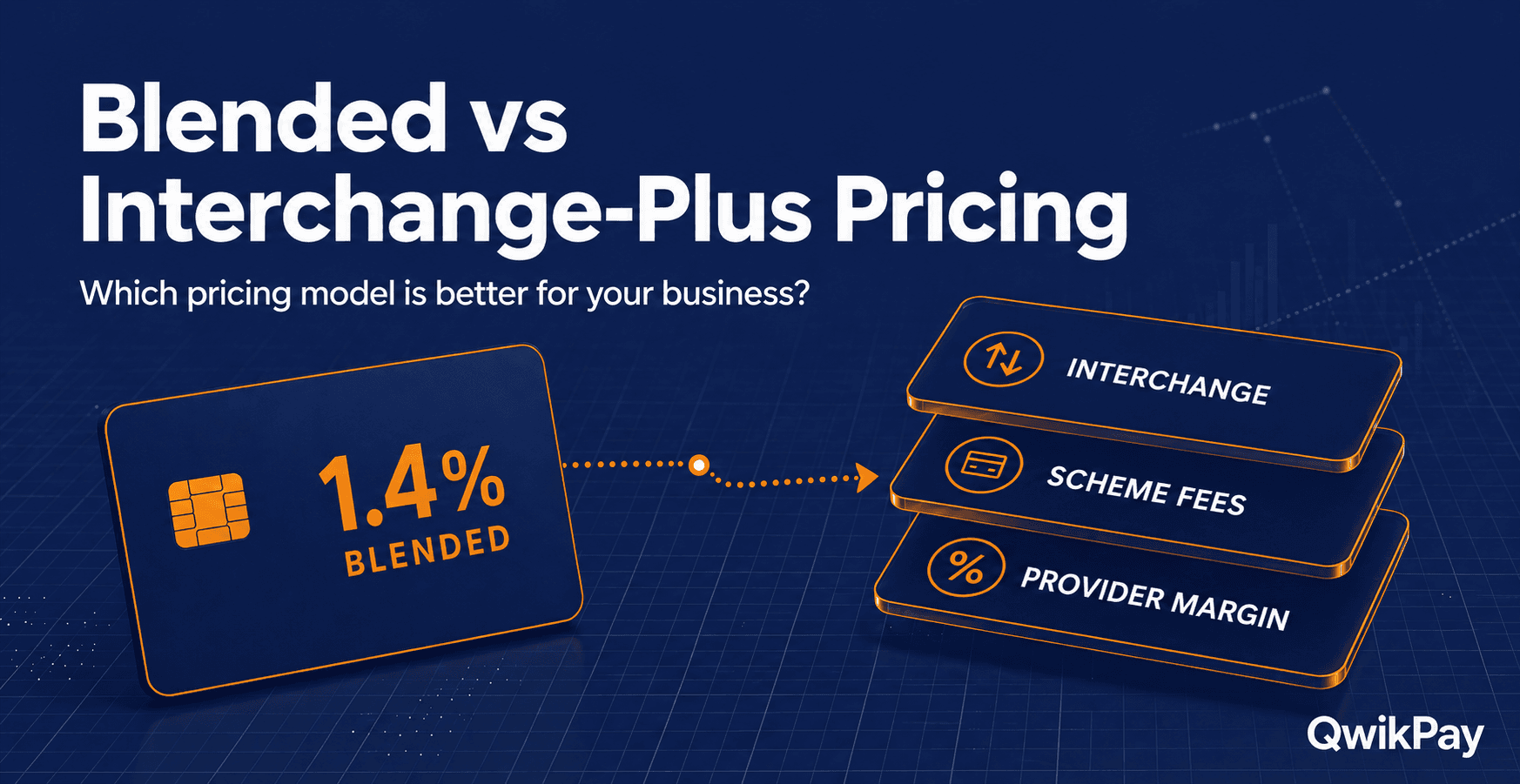
Blended pricing: one flat rate for all cards. Interchange-plus pricing: you see the actual costs plus provider margin. Blended is simpler but opaque. IC++ is transparent and automatically reflects interchange cuts coming October 1.
Blended vs Interchange-Plus at a Glance
| Question | Blended Pricing | Interchange-Plus Pricing |
|---|---|---|
| Which model is simpler? | Blended (one rate for all cards) | IC++ (more complex cost breakdown) |
| Which model is more transparent? | Blended (less detail on cost structure) | IC++ (actual costs visible) |
| Does it reflect interchange changes? | Depends on provider and contract | Yes, subject to contract terms |
| Which is always cheaper? | Depends on volume and mix | Depends on volume and mix |
| What should you compare? | Your effective payment rate (all costs) | Your effective payment rate (all costs) |
What Happens When a Customer Pays by Card?
When a customer taps or inserts their card at your terminal, the transaction flows through multiple intermediaries before the money reaches your account. Each intermediary takes a cut:
- 1The customer's bank (issuer) receives an interchange fee for processing the transaction
- 2Visa, Mastercard, or eftpos (the scheme) receives a scheme fee
- 3Your payment provider or acquiring bank receives their margin for processing
- 4Your account is credited with what remains
Blended and interchange-plus pricing are two different ways of bundling and presenting these costs to you. The underlying costs are the same; the way you see them and how they change over time differs significantly.
What Is Blended Pricing?
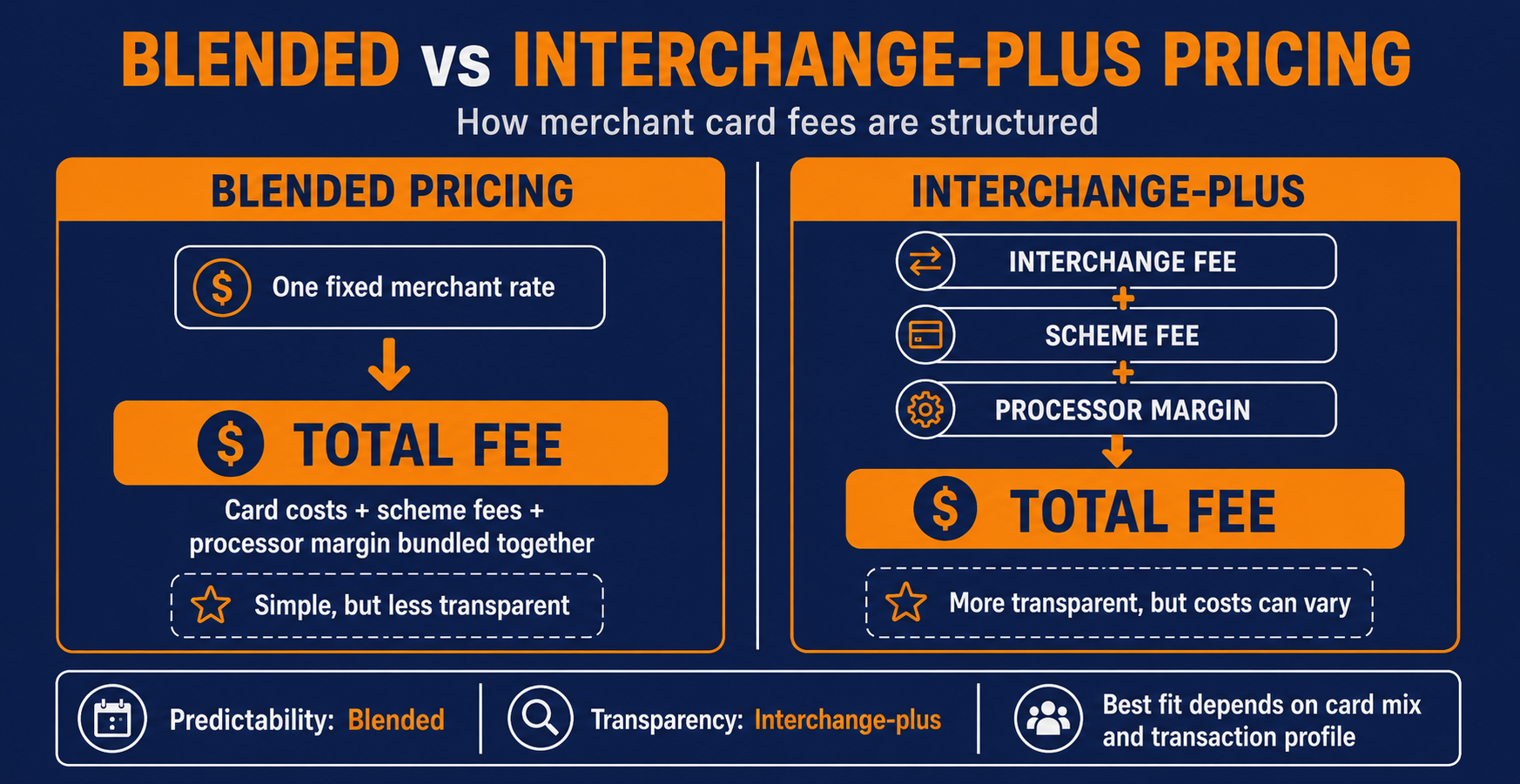
Blended pricing combines interchange, scheme fees, and provider margin into one transaction percentage. If quoted at 1.6%, you pay exactly 1.6% on every card (debit, credit, prepaid, or eftpos), regardless of the actual costs.
Definition: Blended Pricing
A single transaction percentage that combines interchange, scheme fees, and provider margin into one rate. Merchants pay the same percentage regardless of which card network or card type is used.
Advantages of Blended Pricing
- Simplicity: One rate applies to all cards. No need to understand interchange, scheme fees, or card types.
- Predictability: Your per-transaction cost is always the same. Easy to calculate margins and forecast payment costs.
- No surprises: You won't suddenly face a higher rate because customers used more credit cards one month.
- Setup ease: Blended pricing is the standard offering from most payment providers, so it's widely available.
Disadvantages of Blended Pricing
- Hidden cost structure: You don't see the actual interchange or scheme costs. The provider bundles them and keeps any margin.
- No benefit from cheaper cards: If your customers use mostly debit cards (cheaper interchange), you pay the blended rate anyway. The provider keeps the difference.
- No automatic pass-through: If interchange caps fall, the provider is not obligated to pass savings to you. Blended rates may stay the same.
- Potential overpayment: If your business has a favorable card mix (many debit transactions), blended pricing may be more expensive than IC++.
What Is Interchange-Plus Pricing?
Interchange-plus (IC++) shows costs explicitly: actual interchange (which varies by card type) plus a fixed provider margin. For example, "Interchange + 0.4%" means debit at 0.20% costs you 0.60%, while credit at 0.80% costs you 1.20%. You see the breakdown and how interchange changes are reflected in your costs.
Definition: Interchange-Plus Pricing (IC++)
A pricing model where you pay the actual wholesale interchange fee (which varies by card type and transaction details) plus a transparent, fixed provider margin. The margin can be a percentage or flat fee per transaction.
What Does IC++ Include?
IC++ typically includes:
- Interchange: The actual fee charged by the customer's bank. This varies by card type (debit, credit, prepaid, international).
- Scheme fees: Visa, Mastercard, or eftpos fees. Usually bundled as part of the IC++ quote or listed separately.
- Provider margin: The payment processor's profit, expressed as a fixed percentage (e.g., +0.4%) or per-transaction fee (e.g., +$0.15).
IC++ typically excludes terminal rental, monthly account fees, PCI fees, gateway fees, and international markups. These are usually charged separately.
QwikPay Illustrative Example: Retailer Using Interchange-Plus Pricing
A Melbourne retailer processes $50,000 in card payments per month on an IC++ rate of "Interchange + 0.4%". Card mix: 60% debit ($30,000), 40% credit ($20,000). Current interchange caps (as of today): debit 0.20%, credit 0.80%.
| Card Type | Volume | Interchange Rate | Interchange Cost | Provider Margin (0.4%) | Total Fee | Cost |
|---|---|---|---|---|---|---|
| Debit | $30,000 | 0.20% | $60 | 0.4% = $120 | 0.60% | $180 |
| Credit | $20,000 | 0.80% | $160 | 0.4% = $80 | 1.20% | $240 |
| TOTAL | $50,000 | Mixed | $220 | $200 | Blended 0.84% | $420 |
The retailer's effective rate is just 0.84% ($420 / $50,000) because debit transactions are cheaper. With blended pricing at 1.6%, the retailer would pay $800 instead, losing $380/month or $4,560/year.
Advantages of Interchange-Plus Pricing
- Transparency: You see the actual costs. No mystery about what interchange and scheme fees are charged.
- Favorable card mix benefit: If your customers use mostly cheaper cards (debit), your total cost is lower.
- Automatic pass-through: If interchange caps fall on 1 October 2026, your cost automatically falls too (subject to contract terms).
- Cost control: You can see exactly where the expenses are. If your provider's margin is too high, you can shop around.
- Negotiation leverage: It's easier to negotiate the margin (+0.4%) than to renegotiate a blended rate.
Disadvantages of Interchange-Plus Pricing
- Complexity: You must understand interchange rates, which vary by card type, and track them as they change.
- Volatility: Your per-transaction cost is not fixed. If customers use more credit cards one month, costs rise.
- Not always cheaper: If your customers are mostly credit-card users, IC++ may be more expensive than blended pricing.
- Additional fees: Scheme fees, terminal rental, and monthly charges may not be included in the IC++ quote. You must ask.
Blended vs Interchange-Plus Comparison
| Factor | Blended Pricing | Interchange-Plus Pricing |
|---|---|---|
| Simplicity | Very simple (one rate) | More complex (understand card mix) |
| Transparency | Low (costs bundled) | High (cost breakdown visible) |
| Predictability | High (rate fixed) | Medium (rate varies by card type) |
| Setup time | Fast | Slightly longer |
| Pass-through risk | High (no auto benefit) | Low (auto benefit) |
| Benefit from cheap card mix | None (pay blended rate) | Yes (lower with debit-heavy) |
| Best for | Low-volume merchants; simple accounting | Higher-volume merchants; cost-conscious businesses |
Which Is Cheaper: Blended or IC++?
There's no universal winner. Your cost depends on:
- Your card mix: What percentage of transactions are debit vs. credit?
- Your transaction volume: How much you process per month.
- The specific provider: Different providers offer different blended rates and IC++ margins.
- Fixed costs: Terminal rental, monthly fees, and account fees on top of transaction costs.
The only way to know which is cheaper for your business is to calculate your effective payment rate under both models using your actual card volumes.
QwikPay Illustrative Example: Surcharge Impact on a Restaurant
A Sydney restaurant currently processes $80,000 per month in card payments and charges a 1% surcharge (allowed today, but banned from 1 October 2026). It uses Square blended pricing at 1.6%.
| Scenario | Monthly Card Volume | Card Fee (1.6%) | Surcharge Revenue (1% today) | Net Payment Cost | After Oct 1 (no surcharge) |
|---|---|---|---|---|---|
| Today | $80,000 | $1,280 | $800 | $480 | N/A |
| After Oct 1 2026 | $80,000 | $1,280 | $0 (banned) | $1,280 | $1,280 |
| Annual impact | N/A | $15,360 | $0 | $15,360 | $15,360 |
The Real Impact: $10,320/Year Loss
This restaurant loses $10,320 per year in surcharge revenue that it can no longer collect. Every business that currently passes card fees to customers faces this same hit to profitability.
How to Identify Your Pricing Model
Check your merchant agreement or latest invoice:
- Blended: You see one percentage rate (e.g., 1.6%). All cards are charged the same rate. Your invoice shows only the transaction rate, not a breakdown by card type.
- IC++: Your invoice shows "Interchange" + a provider margin (e.g., +0.4% or +$0.10 per transaction). You may see line items for debit, credit, and international transactions at different rates.
If you cannot tell from your invoice, contact your payment provider and ask directly: "Are we on blended pricing or interchange-plus pricing?"
Why This Matters Before 1 October 2026
On 1 October 2026, the Reserve Bank of Australia is cutting interchange fees:
- Domestic debit cards: Interchange will fall from 0.50% to 0.08 cents or 0.16% (whichever is lower).
- Consumer credit cards: Interchange will fall from 0.80% to 0.30%.
- Commercial credit cards: No change (remain at 0.80%).
For businesses on interchange-plus pricing, these savings will automatically flow through (subject to contract). For businesses on blended pricing, the outcome depends entirely on whether the provider chooses to pass savings to merchants.
The Four Merchant Positions
Where your business stands depends on your pricing model and card mix:
- 1Blended pricing, mostly credit cards: You lose the surcharge ($XX/year) and gain nothing from lower interchange. Worst position.
- 2Blended pricing, mixed card mix: You lose the surcharge ($XX/year) and may benefit if the provider passes savings to you. Uncertain position.
- 3IC++ pricing, mostly credit cards: You lose the surcharge ($XX/year) but automatically benefit from lower interchange. Moderate position.
- 4IC++ pricing, mostly debit cards: You lose the surcharge ($XX/year) but gain significant benefit from lower interchange. Best position.
How to Calculate Your Effective Payment Rate
Your effective payment rate is your true cost of accepting payments. It includes every fee, not just the per-transaction rate.
Calculate it this way:
- 1Add up all card-payment costs for 12 months: transaction fees, monthly fees, terminal rental, PCI fees, gateway fees, anything related to card acceptance.
- 2Divide by your total card sales volume for the same 12 months.
- 3Multiply by 100 to express as a percentage.
Example: Total card fees $6,000 / Annual card sales $400,000 × 100 = 1.5% effective rate.
This is your true cost. Compare this rate (not just the transaction percentage) across different providers.
Questions to Ask Your Payment Provider
- Which pricing model are we on: blended or IC++?
- If blended: Will our rate fall if interchange caps drop on 1 October 2026?
- If IC++: Are we guaranteed to see lower costs if interchange falls?
- What is our total effective payment rate (all fees included)?
- How often can the rate be changed, and what notice do we get?
- Are there fees beyond the transaction rate (terminal, monthly, PCI)?
- Can we see a 12-month cost comparison with your rates vs. competitors?
- What is the early termination fee if we want to switch providers?
Why Transparency Matters
Most business owners know the percentage their payment provider charges, but few know their true annual cost. Hidden monthly fees (terminal rental, account fees, PCI fees) often add another 0.3–0.5% to your effective rate.
Before the October 2026 card-surcharge changes take effect, understand your pricing model, calculate your true effective rate, and compare your options, including payment models that don't rely on card networks.
An Alternative: QwikPay
QwikPay operates outside the blended/IC++ model entirely. We use direct bank-to-bank transfers via Australia's New Payments Platform (PayID and PayTo) instead of card networks. No interchange, no scheme fees, no merchant transaction fees. Just $0 per transaction.
Not a Card Processor
QwikPay is designed to help businesses accept payments without traditional card transaction fees. Merchants should review product conditions, settlement, and applicable fees before deciding if this model suits their business.
Frequently Asked Questions
See the FAQ section above for detailed answers to common questions about blended vs interchange-plus pricing.
What to Do Now
Three actions before October 2026:
- 1Calculate your true effective payment rate (all fees, not just transaction %). You'll probably find hidden costs.
- 2Ask your provider whether you're on blended or IC++ pricing. If blended, ask if they'll pass through interchange savings on October 1.
- 3Compare IC++ quotes from other providers. With interchange cuts coming, now's the time to switch if you're overpaying.
Card fees won't disappear on October 1, but they will drop. IC++ merchants benefit automatically. Blended merchants? That depends on their provider's choice.