

Key Takeaways
- Card payments carry interchange fees, scheme fees, and merchant service fees - totalling 0.85–2% per transaction for most small businesses
- From 1 October 2026, eftpos, Mastercard and Visa introduce no-surcharge rules. Businesses cannot pass those costs to customers as surcharges, so they hit margins instead
- PayID and PayTo run on Australia's New Payments Platform (NPP), which sits entirely outside card network infrastructure
- When a customer loads a QwikPay wallet via PayID or PayTo, no interchange fee is charged at any point
- At the counter, the customer scans a QR code - funds move from their wallet to the merchant with zero transaction fee
- QwikPay complements your existing card terminal - it does not replace it
Australian merchants have spent years absorbing card processing fees, passing them on as surcharges, or both. From 1 October 2026, that choice is removed. Visa, Mastercard, and eftpos are introducing no-surcharge rules, which means the fee goes from the visible surcharge column into your cost-of-doing-business column, whether you are ready for it or not.
That leaves one question worth taking seriously: is there a way to accept payments that does not involve card networks at all? The answer has been inside Australia's banking infrastructure for several years. This guide explains how it works. For a detailed breakdown of the RBA's March 2026 ruling, see our explainer: What the RBA Surcharge Ban Actually Means for Your Business.
The Problem with Card Payments for Merchants
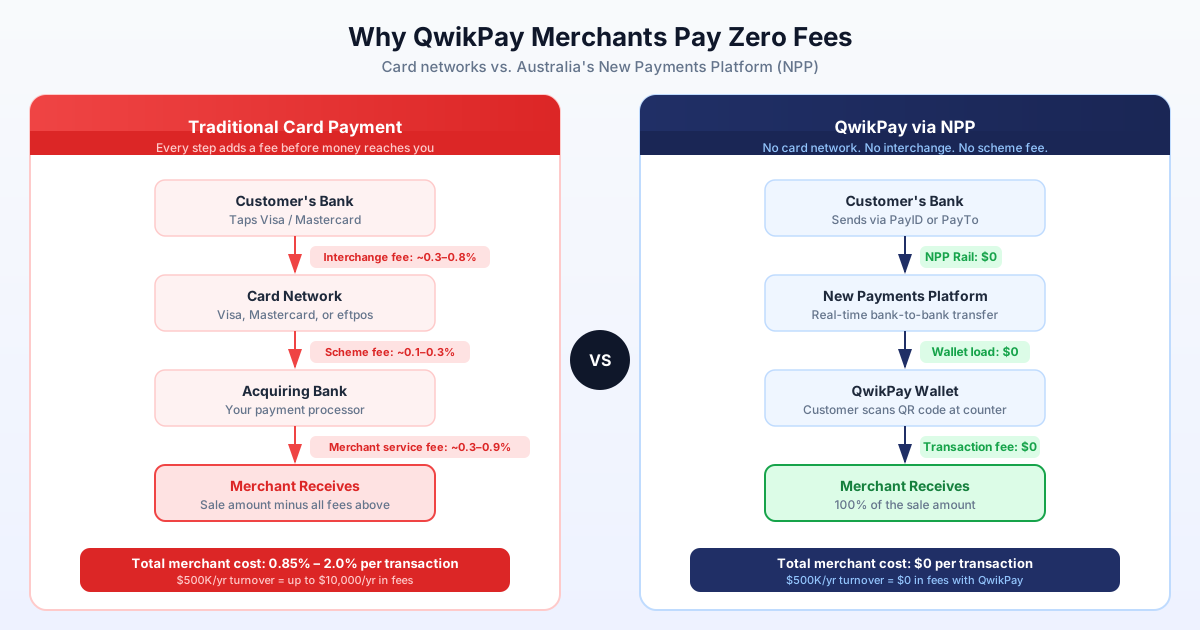
Every card payment involves at least three parties taking a cut before the money reaches your account: the card-issuing bank (interchange fee), the card network - Visa, Mastercard, or eftpos - (scheme fee), and your payment processor or acquiring bank (merchant service fee). For a small business processing under $1 million per year, those combined costs typically run between 0.85% and 2% per transaction.
That structure has not changed under the October 2026 reforms. What has changed is that businesses can no longer show that cost as a line item on the customer's receipt. For a hospitality business running on 3% margins, losing the ability to surcharge is not a rounding error - it is half their profit.
The only structural fix
Lower interchange caps (also coming in October 2026) help, but they do not close the gap to zero. The only way to reach a true zero-fee outcome is to bypass card networks entirely - which is exactly what the NPP allows.
How Customers Load Their QwikPay Wallet: PayID and PayTo
QwikPay uses two NPP-based methods to let customers fund their wallet directly from their own bank account, with no card network involved at any point.
PayID: One-time push from any banking app
The customer opens their banking app, selects Pay Anyone, enters QwikPay's PayID address, and pushes funds into their wallet. Settlement is real time, every day of the year. The transfer runs on the NPP - no card network, no interchange fee, no scheme fee applies.
PayTo: Automated top-ups with one authorisation
With PayTo, the customer authorises a one-time agreement through their banking app. QwikPay then handles automatic top-ups - replenishing the wallet when the balance falls below a threshold, without any manual action required on subsequent visits.
Why this matters for fees
Because the wallet is funded via the NPP - not via a card - no interchange fee exists anywhere in the funding chain. By the time the customer walks to your counter, the expensive part of traditional card acceptance has already been bypassed.
How QR Code Payments Work for Merchants
Once a customer has funds in their QwikPay wallet, paying at your counter is fast and requires no additional hardware from you.
- 1The merchant displays a QwikPay QR code - either a static code for a fixed-price item or a dynamic code generated at point of sale for the exact transaction total.
- 2The customer opens the QwikPay app on their smartphone.
- 3They scan the QR code. Merchant name, amount, and reference populate automatically - no manual entry.
- 4The customer confirms payment from their QwikPay wallet with a single tap.
- 5The merchant receives an instant notification that payment has settled.
The whole process takes roughly the same time as a contactless card tap. The critical difference is what happens behind the scenes: with a card tap, the transaction routes through Visa, Mastercard, or eftpos and fees are deducted at multiple points in the chain. With QwikPay, funds move from the customer's NPP-funded wallet to the merchant - and no fee is charged.
Comparing the Real Cost: Cards vs. QwikPay
Here is what the numbers look like across three common small business types, using a conservative 1.5% blended card processing rate versus QwikPay's zero merchant fee:
| Business type | Monthly card revenue | Card fees (1.5%/month) | QwikPay fee | Annual saving |
|---|---|---|---|---|
| Café | $25,000 | $375 | $0 | $4,500/year |
| Food truck | $12,000 | $180 | $0 | $2,160/year |
| Small retailer | $60,000 | $900 | $0 | $10,800/year |
Run your own number
Multiply your monthly card turnover by 0.015. That is approximately what you would save per month by routing that volume through QwikPay instead. Use our savings calculator on the merchants page for a more precise figure.
What Is the New Payments Platform and Why Does It Matter?
The New Payments Platform (NPP) is the real-time payment infrastructure underpinning PayID and PayTo. Launched in 2018 and operated by New Payments Platform Australia (NPPA), it connects over 100 Australian financial institutions - every major bank and most credit unions.
NPP transactions sit outside the card network ecosystem. There is no Visa, no Mastercard, no eftpos involved - and therefore no interchange fee, no scheme fee, and no card processing charge. QwikPay uses the NPP as the funding rail for its wallet. When a customer loads funds via PayID or PayTo, those funds travel through the NPP from their bank account at full value. No card network touches the transfer.
How QwikPay Works: The Full Wallet Model
- 1Customer loads their QwikPay wallet using PayID (one-time push) or PayTo (automated top-up agreement). Both methods run on the NPP. No card is involved. No interchange fee is charged on the top-up.
- 2At your counter, the customer opens the QwikPay app, scans your QR code, and confirms the payment amount. Funds move instantly from their wallet to your merchant account.
- 3You receive 100% of the transaction value. No interchange fee. No scheme fee. No merchant service fee. No terminal rental.
No EFTPOS terminal required
Merchant setup involves registering with QwikPay, linking a business bank account, and displaying a QR code at the point of sale. There is no terminal to rent, no monthly hardware cost, and no contract lock-in. Your existing card terminal stays exactly where it is.
Is QwikPay Right for Your Business?
QwikPay works best in environments where:
- Customers are comfortable using a smartphone app to manage a payment wallet
- Transaction values are meaningful enough that card fees represent a visible cost
- The business wants a surcharge-free payment option without absorbing card processing costs
- Speed and simplicity at the point of sale matter
- The business processes recurring customers who benefit from automatic wallet top-ups via PayTo
QwikPay complements, rather than replaces, card terminals. A merchant who accepts both card payments and QwikPay gives customers a choice - and gives themselves a zero-fee alternative to actively promote. For customers who prefer cards, the existing terminal stays. For users comfortable with a digital wallet funded from their own bank, QwikPay provides faster checkout and a fee-free transaction for both sides.
The card-surcharge changes address the symptom. QwikPay addresses the cause.
Getting Started
Accepting payments with zero merchant fees does not require switching infrastructure, cancelling your EFTPOS contract, or retraining your team. It requires a QwikPay merchant account, a QR code at the counter, and a brief explanation for customers about loading their QwikPay wallet before they visit.
Get 6 months free
Merchants who sign up today get QwikPay free for 6 months. Setup takes under 5 minutes. No lock-in contract. Your existing terminal is unaffected.
The Bottom Line
Card processing fees are a structural cost built into the card network system. Lower interchange caps reduce them - but they do not eliminate them. QwikPay is a structural alternative: an NPP-powered wallet that customers fund using PayID or PayTo, and spend at merchants via QR code, with no card network involved at any point.
For Australian merchants facing the removal of surcharging from October 2026 and the ongoing reality of interchange fees, scheme fees, and merchant service charges, QwikPay offers a different foundation entirely. The fees are not reduced. They are removed.